
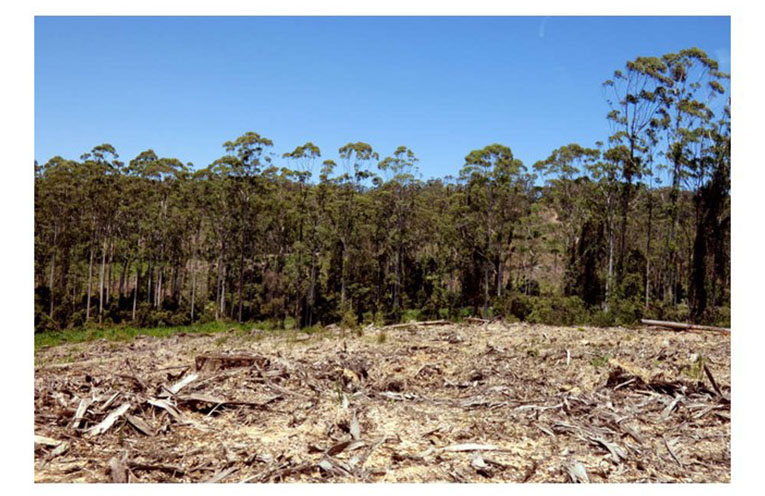
BIOFUEL is a term becoming more widely used to describe a range of practices to mitigate climate change.
 Advertise with News of The Area today.
It’s worth it for your business.
Message us.
Phone us – (02) 4981 8882.
Email us – media@newsofthearea.com.au
Of local interest is the wood chipping of waste timber left after logging, which is then pressed into pellets to be burnt.
However, not everyone is convinced that only waste timber is wood chipped.
Two environmentalists have raised the possibility that native forest timber is being used for fuel in Way Way Forest near Macksville on the Mid North Coast of NSW.
According to Michael Jones, an environmental scientist who has worked with the National Parks Association, a mix of gum tree species have been logged, including bluegum trees (a koala feed tree), and cut into short lengths.
Mr. Jones said that he had contacted several Forestry Corporation officials and could not find out if the logs were being wood chipped, or not.
Frank Dennis, a spokesperson from No Electricity From Forests” (NEFF), has said that “The government, and sections of the timber industry, seems intent on continuing their ‘war on forests’ here on the North Coast.
He claimed, “Their serious mission for years has been to provide a supply of small logs to the burgeoning worldwide market for wood pellets, forest biomass and to burn as fuel to produce electricity both here and overseas in countries like Japan”.
Mr. Jones and Mr. Dennis say that new forestry rules will allow 140,000 hectares of forests to be virtually clear-felled from south of Taree to Grafton, in areas of up to 60 hectares (previously 0.25hectares), converting complex forests types into single species monocultures, mainly blackbutts.
As well, burning wood for electricity produces more CO2 than burning coal and it takes decades for trees to grow and tie up the carbon again.
They say that large volumes of native timber are required to keep this industry going and the claim that “waste” timber, only, is to be used is totally misleading.
Closer to the Coffs Coast, concern has also been raised about onsite wood chipping in the Tarkeeth State Forest.
Forestry Corporation’s response to wood chipping claims is that clear felling does not occur in state forests such as Way Way.
It said that the timber plantations in the Tarkeeth State Forest are not natural forests but have been specifically planted on previously-cleared farmland during the 1960 and 70s for timber production.
These mature timber plantations been progressively harvested within the Tarkeeth State Forest and there has been replanting of the entire plantation area with the next generation of locally grown native seedlings over the past few years.
Forest Corporation says it is carrying out a trial to remove by-products already on the forest floor that are not suitable for use in traditional timber products to produce biomass instead of burning them on the forest floor.
It adds that the primary product coming out of the forest remains quality timber needed by the community, especially in the post-fire rebuilding effort and the residue sold for biomass is just that, residue.
Caroline Joseph, from the Bellingen Environment Centre said that logs cut into shorter lengths have been observed in the Tarkeeth State Forest, near Bellingen.
She also said that the combination of clear felling and onsite wood chipping causes additional problems.
She told News Of The Area, “The land is absolutely denuded after the clearing and wood chipping, so any run off goes straight into the nearest waterway.”
By Andrew VIVIAN